
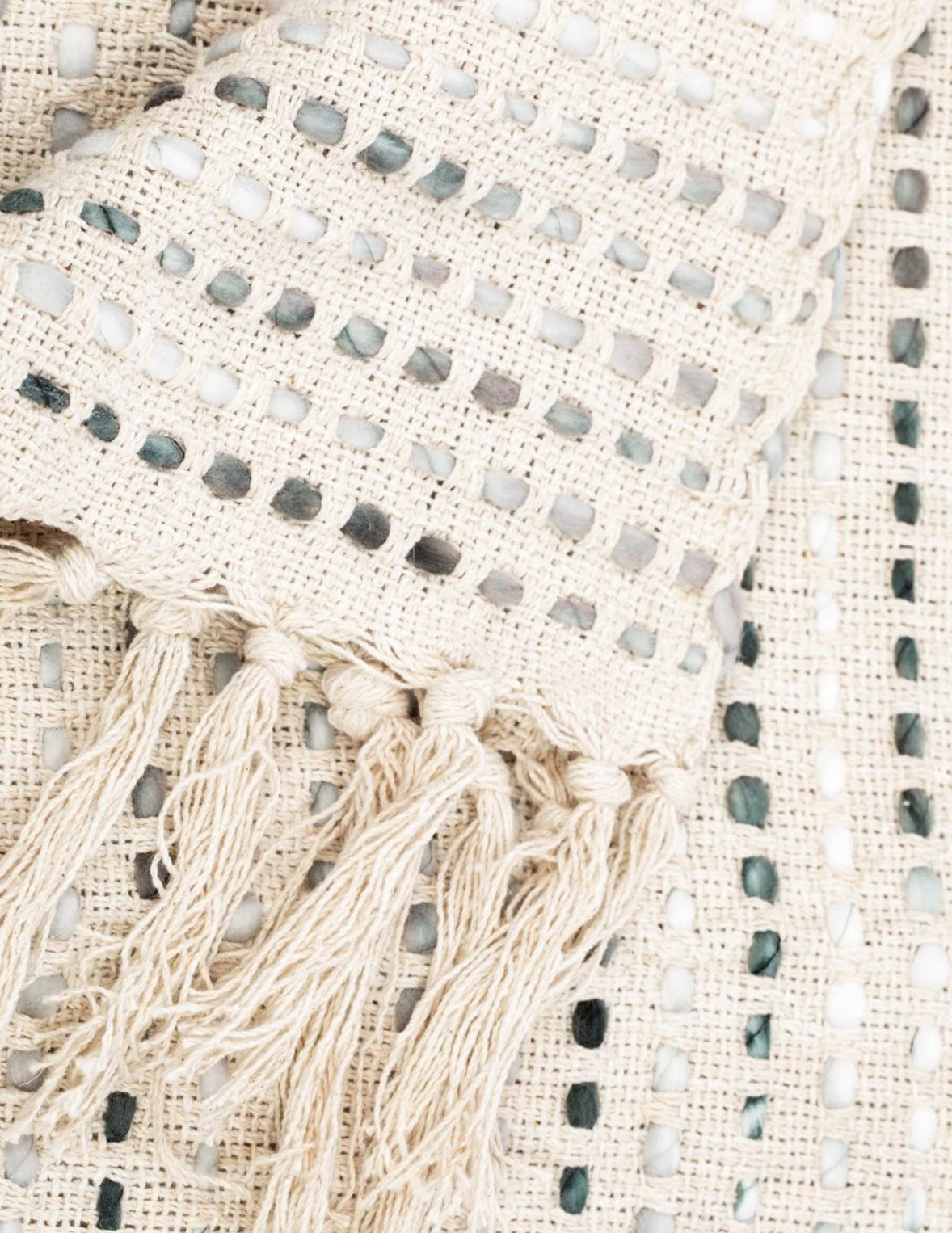
A heavy blanket wants one thing: warmth on a cold night, wool-thick and folded away in a chest until it's needed. A decorative throw blanket wants something else. It stays out on the sofa or the foot of the bed year-round, doing more design work than warming work, which means it shouldn't be shopped for the same way. The weight that makes a blanket good at keeping someone warm is often the same weight that makes it stiff, hard to drape, and visually heavy in a room that doesn't need another bulky object competing for attention.
Warmth Isn't the Assignment
A throw chosen for a finished room is doing a different job: introducing texture, breaking up a solid-color sofa, adding a band of color a pillow arrangement alone can't achieve. Once warmth drops from being the primary requirement, the fabric options open up considerably — linen blends, brushed cotton, lightweight wool, loose-weave cotton gauze — none of which will keep a person warm on a genuinely cold night, and none of which are trying to. Judging one of these against a sherpa throw on an insulation basis misses what it was made for.

Drape Is a Function of Fabric
A throw's weight determines whether it falls in soft, loose folds or holds a stiff, boxy shape that looks propped rather than placed. Heavier knits and thick wool blends tend to hold their shape — fine for a chair back, less forgiving when draped over an arm or folded at the foot of a bed, where the goal is movement, not structure.
Lighter weaves behave differently. A linen-cotton throw, or a lightweight wool with some give to it, will fold, fall, and pool in a way that reads as unstudied even when it isn't. This is why the same throw can look considered on one sofa and slightly wrong on another — the fabric's hand, not the color, is usually the variable doing the most work. Before choosing a throw for how it looks rather than how it insulates, it's worth handling it in person if possible: pull a corner, let it hang, see whether it wants to fall into a fold or fight to hold its shape. A throw that fights the drape will always look a little off, regardless of how good the color is.

What a Decorative Throw Blanket Owes to Design
Design is where a decorative throw blanket earns its keep. A solid sofa in a neutral upholstery, or a plain linen slipcover, benefits from a throw that introduces a concept — not matching, not clashing, just present. Pairing a throw in ecru that carries a bold, graphic pattern warm against a pillow arrangement built around pieces in varied creams and oat gives a sofa a tonal range a single fabric can't provide on its own.
The mistake is treating the throw as an accent that has to coordinate exactly with everything else in the room. It doesn't. A throw in a warm, saturated color can sit against a cooler pillow palette and the contrast reads as intentional rather than mismatched, provided the undertones are related — warm reds and rusts against blue-greys, ochres against sage, cream against midnight. The relationship between undertones matters more than an exact color match, and it's usually the thing people get wrong when they try to buy a throw and a pillow set as if they were one product.

It Finishes an Arrangement, Not Just a Sofa
A throw folded over the arm of a sofa, or draped loose across the back, does something a pillow arrangement can't: it adds a horizontal line that breaks up the vertical repetition of stacked squares and lumbars. Without it, even a well-chosen pillow pairing can look like it's floating on top of the furniture rather than settled into it.
A decorative throw blanket doesn't have to keep anyone warm to be worth buying. It has to drape well, hold a color that does something for the room, and read as chosen rather than default. Buy the heavy knit for the guest room upstairs where the radiator doesn't quite reach. Buy something lighter, in a color with some real relationship to the pillows already on the sofa, for the room where people actually sit.

Share:
What Makes a Pillow Pairing Work
Olive, Ochre, and Rust: Styling Warm-Toned Pillow Combinations