


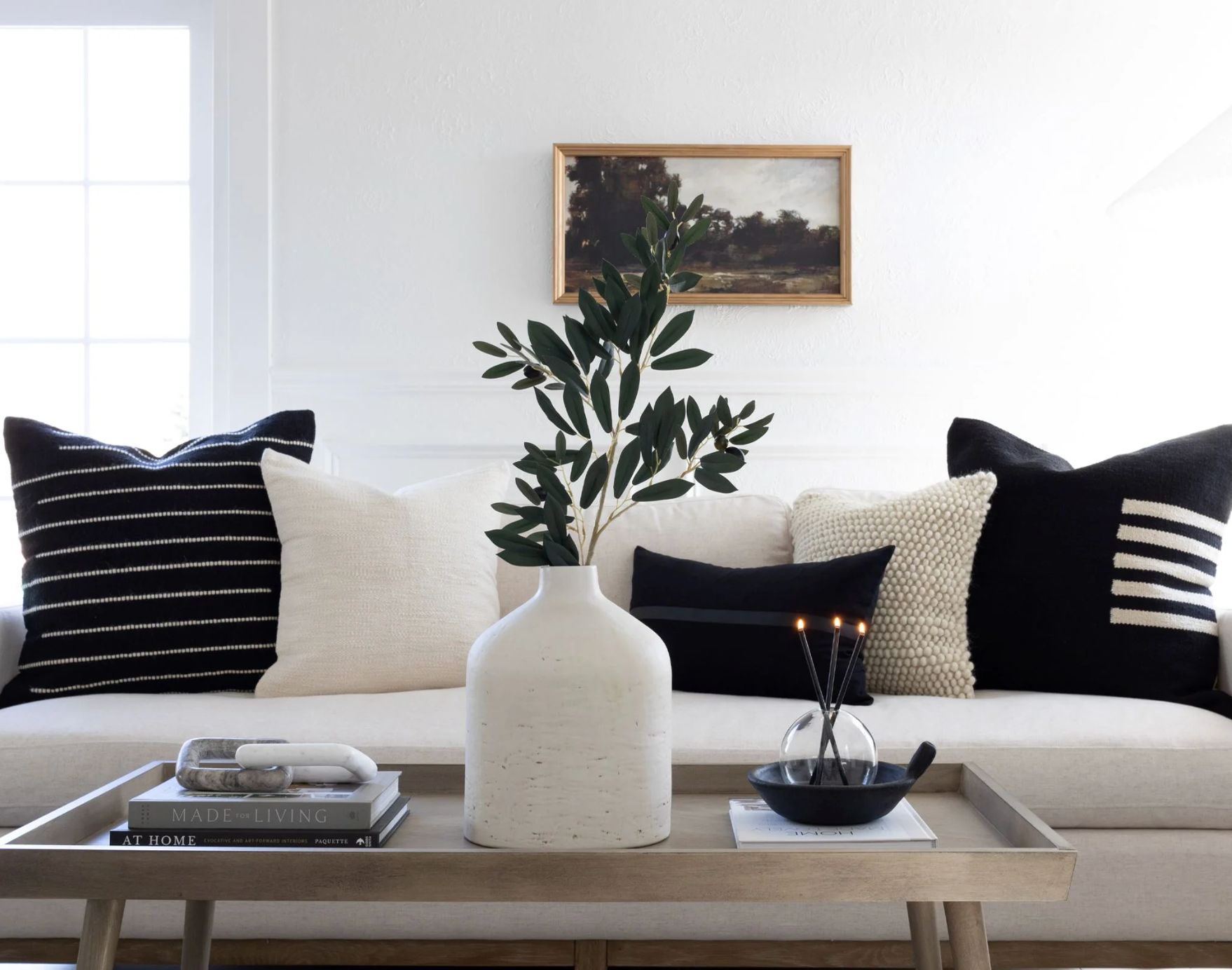
Most sofas get styled with pillows that are all the same size, while that is one option it isn't the only one. A row of matching sized squares can look like a showroom setup — even spacing, even scale, nothing for the eye to catch on. The correction is varying the throw pillow sizes so the arrangement has structure: a larger anchor at the outside, something smaller in front of it, a shape at the center that breaks the grid. Scale is what makes a group of pillows look composed.

Scale does the work before color does
Pattern and color get the attention, but size decides whether an arrangement holds together. A pillow's first job is structural. It fills the depth of the seat, softens the hard top line of the back cushion, and gives you something to lean into that isn't the frame. When every pillow shares one dimension, none of that registers — the eye takes in the repetition and moves on.

The difference in scale is what builds depth. Set a 24-inch pillow behind a 20-inch one, and the smaller one sits forward while the larger one frames it, and a piece of furniture that's essentially a flat plane suddenly has a foreground and a background. Pattern, fill, and placement are all refinements that come after. The scale is the foundation they sit on.
Throw pillow sizes aren't interchangeable
The four square sizes worth knowing are 18, 20, 22, and 24 inches, and each one behaves differently.
Eighteen is small. On a standard-depth sofa it can look undersized, and on a deep sectional it vanishes. Its real use is as the front layer in a stack, or on a compact loveseat where anything larger would crowd the seat.
Twenty is the workhorse. It suits most sofas as the primary pillow, and there's nothing wrong with reaching for it first.
Twenty-two and twenty-four are what deeper and larger sofas need. A three-cushion sofa or a sectional has the mass to carry a 24, and a pillow that size reads as deliberate rather than lost against the cushions. They also do something quieter: they make a 20 placed in front of them look genuinely small, which is the contrast that gives an arrangement depth.


Whatever size you land on, the insert has to fill it. Go up an inch or two on the insert and the cover holds its shape, which is the entire reason you sized up to begin with.
Building the arrangement from the corners

Work from the outside toward the middle. The largest pillows belong in the back corners, a 24 or a 22 set into the angle where the back cushion meets the arm. Put a 20 in front of each, and the corner gains depth.
The center is where the arrangement is won or lost. On a smaller sofa, one accent — a 20 or an 18 in a texture that plays against the corners — is enough. On a longer sofa or a sectional, the center wants the lumbar, laid horizontally across the front. That horizontal line does what a fifth upright square can't: it breaks the rhythm of the standing pillows and keeps the whole thing from reading as a row.
Odd groupings settle more naturally than even ones. Five pillows on a standard three-seat sofa — two large, two medium, one lumbar or accent — is a dependable starting point. Perfect symmetry suits a formal room; a slightly uneven hand reads more lived-in, which is usually what you're after.
We’ve got you covered and have considered these all of these factors, just choose the palette that fits your space - SHOP our Curated Combinations!
Share:
Mudcloth Pillows: The Malian Cloth that Changed Decor
Pillow Cover Fabrics Explored: Linen, Velvet, and Bouclé